NATHALIA FAVARO
This is my Raumstrategien Master's Presentation at Weissensee Kunsthochschule Berlin, Germany, in October 2025. I would like to thank all my Professors and Mentors:
Bonaventure Soh Bejeng Ndikung, for understanding what it was all about since the beginning.
Tonderai Koschke, my mentor, for accompanying me in the writing, in listening attentively and helping to find words when I couldn’t.
Lerato Shadi, my mentor, for vibrating with me, remembering me to enjoy the process.
Paz Guevara, for bringing new reflections about clay.
Pauline Doutreluingne, for your words and vision for the final presentation.

“She unwrapped her clay figures,
unfolding the cloth each was nestled in,
carefully, almost with ceremony.
Concerning herself with the specific curves,
bends and idiosyncrasies,
that made each piece her own.
Standing these forms upright, displaying them from
one side to the next, Mud Woman could feel
her pride surging upward from a secret part within her,
translating into a smile that passed her lips.”[1]
[1] MORSE, Nora Naranjo-, Mud Woman - Poems from the Clay. Extracted from the poem “Mud woman’s first encounter with the world of money and business.” The University of Arizona Press Tucson & London, 1992, 127 pp, page 34.
This exhibition is an invitation to look at matter as a way of being in relation and to think in ways to dialogue with other beings’ when the communication isn’t the same. When language go beyond words, through looking, touching, feeling, holding, caring, being present. Proximity.
To believe in the transformation of matter is to believe in process. In something that changes, that folds in different directions. In intentions that drift, in drawings that dissolves, in forms that deforms. In pieces that need to be put together to became something else.
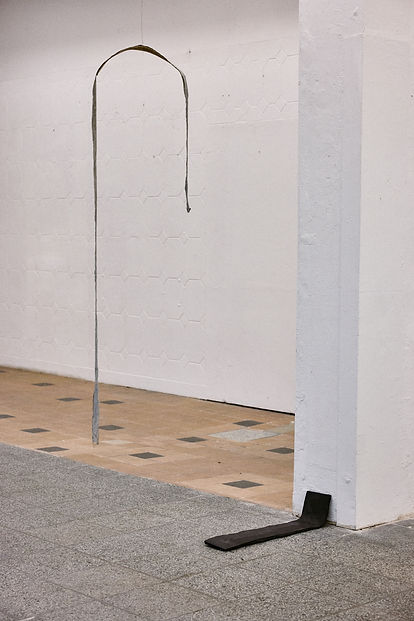
In this body of works, the fabric invites us to think of interweaving - the possibility of being modified when touched or brought into contact with another, even a small piece of ceramic, raw or fired. The fabric as thought, life, transformation. Clay as support, earth, a piece that sustains the process. Yet only a fragment: fragile and strong.
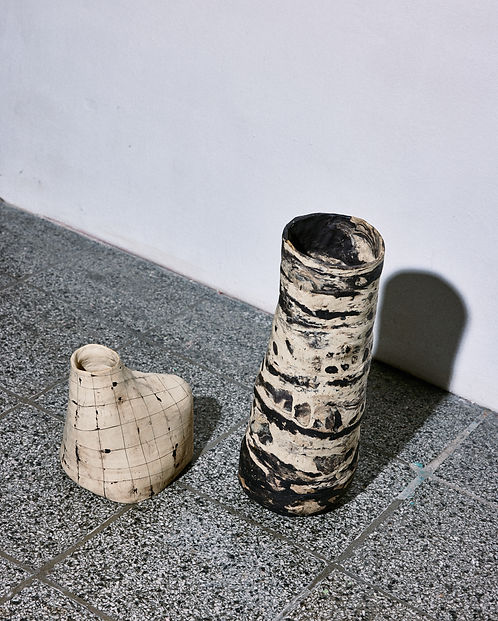
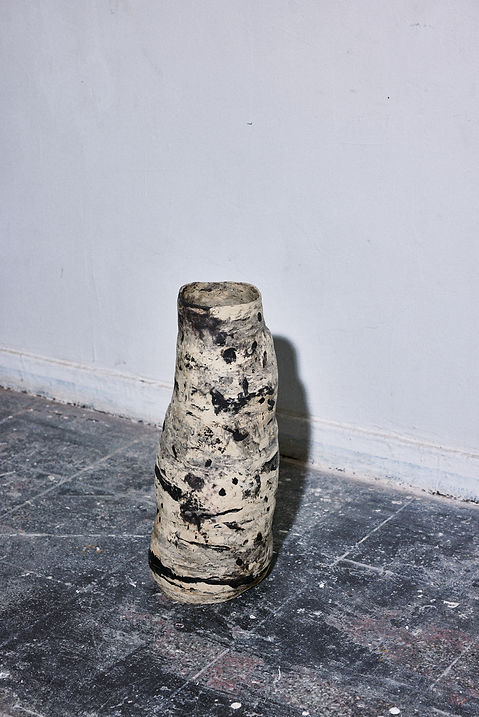
In the space, ceramics are beings. Standing here, there, in a corner, with others. Being on their own, having presence as bodies and souls. Each piece becomes a place where thoughts and emotions decant into form.
Here, perceiving the world is understood as daily life and artistic processes intertwined.


making ceramics
is like playing
an instrument.
a composition of
one piece at a time
one part,
then another,
and another.
all together
like music,
with no sound.
silence
after all,
like architecture,
frozen music.